Mostrando postagens com marcador AULA 22 - VERBOS MODAIS - 2. Mostrar todas as postagens

sábado, 17 de março de 2018

Modals of Certainty #2 - Intermediate English with Shaun #55

More people slowly sauntering in here today

Mais pessoas lentamente passeando aqui hoje


I am supposing, I am assuming or speculating


Now this type of supposing you cand o a lot of topics

He may have been I mean he seems to be listening for something


When you think you are certain about something or you're not completely sure about something we talked about the modal verbs you use to express
THE PERFECT INFINITIVE
- Have + past participla
have eaten
have studied
have gone
have finished
have bought

Where was John today?
He might have taken a sick day.

He must have been hungry. He hadn't eaten anything all day.

ALMOST 100% CERTAIN
If you feel very certain but not quite 100% you use the word must

You were in France for vacation?
You must have eaten some amazing food!
(I could be wrong)

She must have blocked me on facebook

two dots

Amy must not have left yet. Her car is still parked out front.
Amy couldn't have left yet. Her car is still parked out front.
Amy can't have left yet. Her car is still parked out front.
All these three of these mean the exact same thing therefore you have choice

NOT CERTAIN

She might have overslept. ( I don't know for certain this is just my own idea right)
She may have missed her bus.
She could have run away and joined the circus.
She might not have set her alarm.

*below that's a good one right
*That's perfectly reasonable as an explanation

Their skin is really tanned. (Go on holiday) They must have gone on holiday.
She looks really tired today. (sleep well last night) She may have not slept well last night.
When I came back to the room, my computer was gone. (steal) Someone might have stolen it.
He told me he was going to the party, but I didn't see him there. (change) He must have changed his mind.
I went to a new restaurant last night. Now, it my favorite resturant. (be delicious) It must have been delicious.
We made plans to meet but he didn't show up. (forget) He might have forgotten our plans.

She must've overslept.
fica parecento She MUST OF overslept.
*my typing

I never see James and Jessica together anymore. (break up)  They must have broken up.
My pants are too tight for me now. (gain weight) I must have gained some weight.
Many people are leaving the stadium in a good mood. (win) They must have won the game.
Steve's car is from a different country. (transport from overseas) He must have transported it from overseas.
Her apartment is great now. (clean up) She must have cleaned up.

Can you spot the mistake?
He couldn't find the information he needed to answer his question, but he may have been looking in the wrong website.
preposition não é in e sim on

*shut up
*pop out
*throw you off
*tricks


sexta-feira, 16 de março de 2018

Modals of Certainty #1 - Intermediate English with Shaun #54

Modals of Certainty #1 - Intermediate English with Shaun #54


AULA 1
We're going to talk about certainty. How to express certanty in Enlgish.

hopelly

Certainty (noun) - is a felling more than anything you feel that right
- to be sure
- to know something
     100% - without any doubt
      no doubt


and to simplify you see this TY ending on that word. That is a pretty clear sign that we're looking at a noun all right. But if you take that T Y away and you just left with certain. Well that's an adjective right

Certain has different meanings depending on the sentence that you're using, depepnding on the context.
related to certainty has to do with being sure. Are you sure certain about something
How sure you are about an answer or about information
How certain are you?
So even though the word certain should mean 100% we can be almost certain right but not entirely certain
I mean you could you can apply this to so many things about the future right
how certain are you about your future
Where are you going to be in ten years

AULA 10-1 PRESENT CERTAINTY

very - sleek

Do you know where John is?
No, I don't. He might be on a break

Modal verbs
- auxiliary verbs - different from other helping verbs right like be or have because they can give meaning to the sentence
- give meanin, express feelin
-will, should, can, might, etc
- can help to show our level of certainty
- how certain we feel about something

100% certain
When you want to express that you are a hundred percent certain about something and I mean a hundread percent no doubt at all
You don't really need a modal verb actually

Do you know where John is?
He is on his break.

You know something is a fact and it's not a an opinion or feeling at all


ALMOST 100% CERTAIN
A little room for doubt
- must
- have/has to
- have/has got to
 (os dois ultimos) These are not technically modal verbs but they function in the same way as must

A:Do you know where John is?
B:He must be on his break.
A:He has got to be on his break.
B:Maybe he didn't come to work today.
A:No, we have an important meeting today. He has to be here.

*Has to is a little bit stronger
*Must is more commonly used

coworker

we share an office okay

every morning at 9 o'clock on the dot Monday to Friday

He must be hungry. He hasn't eaten anything all day.

Amy has to be here, That's her car parked out front.

I just want to hug it


NOT CERTAIN
- may
-might
- could

Do you know where John is?
No, I don't. He might be on a break.
No, I don't. He may be on a break.
No, I don't. He could be on a break.

should - you think that is the best

We can also express certainty with negative sentences:
100% certain
Do you know where John is?
He isn't here today.

ALMOST 100% CERTAIN
- can't - very unlikely or impossible
- must not

He can't be here today. He was just in London yestterday, wasn't he?
He must not be in today.


VOCÊ NÃO PODE USAR MUSN'T - contrair
when you talk about certain.


NOT CERTAIN
- may not
- might not
don't say could not

He might not be in today.
He may not be in today.

can't is more stronger


They have been traveling for over 22 hours. They must be exhausted.
John has 4 jobs. He can't have musch free time.
That suitcase is really big. It's got to weigh a ton.
I can hear fire trucks. There must be a fire somewhere close by.
Sam hasn't come to school today. He may be sikipping.
This look like John's coat. He must be freezing.
She never sees her husband. She may be blind.
When I read, I always get headches. You might need glasses.
I lost $500 dollars at the casino last night. Oh, no. You must be joking.


CONTINUOUS FORMS
We can use modals with be + verb ing to mean that something is in progress now.
It can't be raining. It was sunny ten minutes ago!
She must be sleeeping. She isn't answering her phone.

....

quarta-feira, 14 de março de 2018

avançado - modais verbos


Upper Intermediate English with Kent #15

Aula em inglês - avançado
modais verbos no passado

segunda-feira, 1 de agosto de 2016

VERBOS MODAIS - AULA 2 - Livro Positivo


Fazer um de cada regra explicando


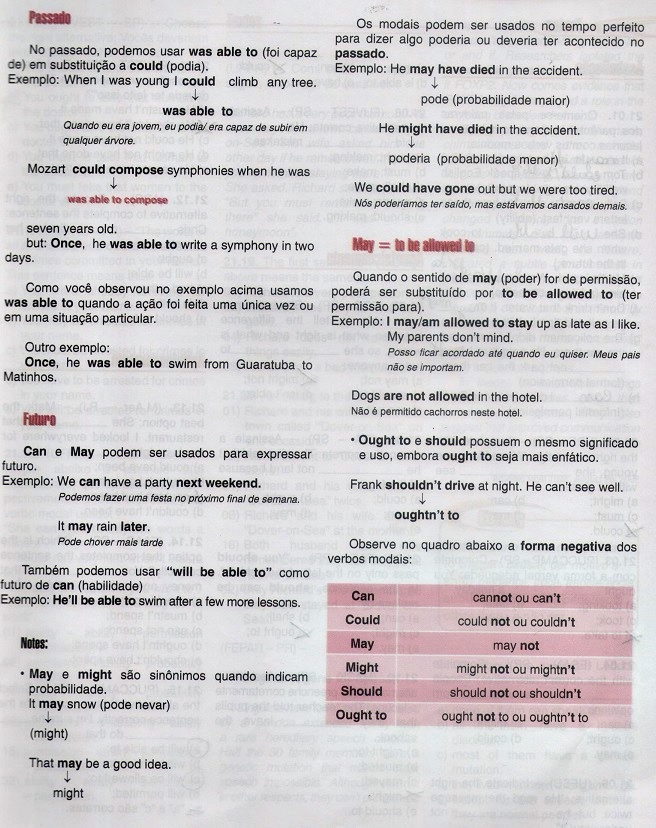
CAN - COULD - MAY - MIGHT - MUST - SHOULD - OUGHT TO - TO ABLE TO 

1
Isso pode ser verdade.
Isso poderia ser verdade.
It (may/might) be true. (Possibility)
*may = possibilidade
May and might = probabilidade
2
 Tom podia falar inglêsEngish bem há 5 anos
Tom (could/ to able to) speak English well 5 years ago.
*passado = could  e não can
(Capacity)
*Habilidade e presente - can
3


4
Sally é capaz de escrever essas cartas muito rápido.
Sally pode escrever essas cartaz muito rápido.
She will be able to cook when she gets married. (capacity in future)
*Futuro = will be able
*passado = could
*presente = can
5
Martin está doente. Devemos visitá-lo.

Martin is sick. We ( should/ ought to) visit him. (Advise = conselho)
*Conselho= should = deveria
6
Não beba está água. Pode está poluida.
Don’t drink that water. It (may/ might) be polluted.
*May and might indicam probabilidade.
7
O policial não me deixou estacionar o carro lá. Ele disse que eu não podia estacionar o carro lá.

The policeman didn’t let me park the car there. He said that I (might) not park the car there. (formal permission)
*could é menos formal, e can menos ainda.
Might – podia (passado) e não may (presente)
8

Posso conduzir o seu carro , pai?
Can I drive your car, Dad? (Informal permission)
9
Quando May era jovem , podia ver sem óculos.

When May was young, she could see without glasses.
10
Você deve tomar um feriado.

You ought to take a holiday.
11
Ele leu a mensagem duas vezes, mas ele não podia entendê-la

He read the message twice but he could not understand it
*can = passado.
12
Ela nunca foi capaz de dizer a diferença entre o que é certo eo que é errado , então ela pode não julgar ninguém

She has never been able to tell the difference between what is righ and what is wrong, so she might not to judge anyone.
Pq esse able não tem is?
13
O professor disse aos alunos que eles podem deixar a escola
The teacher told the pupils that they might leave the school.
14
Ela não podia ter estado naquele restaurante . Eu olhei em todo lugar por ela ontem à noite .

She couldn' had been at that restaurant. I looked everywhere for her last night
15
Ele não deveria ter feito isso.
He shouldn’ have done that.
16
Tenho certeza que ele será capaz de fazer isso.

I'm sure he will be able to do that.
I’m sure he will be allowed to do that.
17
Há tanto crime hoje! Nos velhos tempos, as pessoas não precisam bloquear as suas portas como fazemos agora.
There is so much crime today! In the old days people needn’t lock their doors as we do now.
18
Mãe para filho : Você não deve dizer mentiras .

Mother to child : You mustn’t tell lies.
19
Minhas férias são longas. Tenho que voltar ao trabalho imediatamente, senão eu vou perder meu emprego.
My vacation is over. I must get back to the work immediately, otherwise I’ll lose my job.
20
Tenho certeza que ele não está na escola agora. Ele deve estar no trabalho.
I’m sure he’s not at school now. He must be at work.
21
Olhe para os olhos, ele deve ter bebido a noite toda.
Look at his eyes, he must have drunk all night.
22
Eu não senti a necessidade de ficar em forma
I haven't felt the need to stay in shape
23
Eu prefiro ser um pardal do que uma lesma.
I'd rather be a sparrow than a snail.
24
Ele deve ir agora.
SHe must go now.
25
A criança pode ter brinquedo?
May the child have the toy?